In an increasingly competitive market, OEMs and machine builders are looking to add new value to their machines and integrate new offerings. Optimizing industrial operations and creating digital services requires a solid foundation: reliable, accurate machine data that is available in real-time to allow for fast decision-making and seamless operation.
Acquiring this data means connecting machines and distributed assets to each other and to the cloud, so engineering teams can capture sensor data for their applications. Edge computing with processing close to the data source at the machine supports faster decisions and actionability and ensures that data can be pre-processed and only transferred to the cloud if needed. Cybersecurity, the protection of data and proprietary information, as well as managing software and security requirements over the system’s lifetime are key considerations.
Getting from sensor data to secure edge insights
The combination of reliable data acquisition and certified edge computing in a cohesive architecture is the foundation for a range of use cases, from machine monitoring to predictive maintenance or remote service.
Benoli Tech and TTTECH Systems provide such an IIoT architecture by combining the SensoBlock sensor data acquisition solution with the edge computing platform Nerve. As both solutions are modular and scalable, they can be applied both to new machine concepts and digitalization projects, and for retrofitting machines in brownfield environments.
We sat down with Miodrag Veselic, Senior Sales Manager Industrial IoT, TTTECH Industrial and Alex Negoita-Tiu, CEO at Benoli Tech to discuss the basis for digital services and how their products and the joint solution support OEMs and machine builders.
How can OEMs generate actionable, reliable insights into their machines to use for digital services?
Alex Negoita-Tiu, Benoli Tech: Reliable insights start with reliable machine data. You may want to measure physical parameters such as vibration, temperature, pressure, humidity, or motion to learn about the status of the machine. Coupled with proper analysis, this is the basis of a predictive maintenance solution that notifies you if the machine function is compromised or a component needs to be replaced before a standstill occurs.
Miodrag Veselic, TTTECH Industrial: Digital services often require real-time data and immediate actionable decisions – this means you have to process data close to the source, i.e. at machine level. This is where edge computing comes in – it allows OEMs to immediately work with machine data, while enabling them to decide which part of the data should be stored or sent to the cloud for further analysis.
What are the features and key benefits of SensoBlock and Nerve?
Alex Negoita-Tiu: SensoBlock is a data acquisition and processing unit that interfaces with a wide range of industrial sensors to capture physical machine parameters, perform edge filtering to remove duplicate or low-value samples, and reduce unnecessary data volume.
Typical sensor configurations include: high-frequency vibration and structural monitoring, temperature and pressure measurements in machinery, environmental sensing for humidity, air quality, or motion, and connectivity to a broad range of industrial sensor interfaces. Once collected from the sensors, the data is forwarded in real-time through secure communication channels for further processing and analysis, for example to the Nerve platform.
Miodrag Veselic: Nerve is a cybersecurity-certified, industrial grade edge computing platform that runs analytics, rules, and artificial intelligence (AI) workloads close to the machine. It supports both containerized and virtualized workloads, hosting and securely encapsulating (legacy) applications from a range of vendors. OEMs have the choice of both cloud and local, offline operation. Signal processing, feature extraction, and machine learning inference can run independently of cloud connectivity, allowing real-time reactions and reducing unnecessary bandwidth consumption.
Security is a core part of Nerve. Its IEC 62443 4 2 certification means it provides a certified cybersecurity foundation that supports CRA readiness and helps address NIS2-related cybersecurity requirements. This means that Nerve provides mechanisms for secure updates, integrity and authenticity checks, controlled deployment workflows, logging, and traceability. Nerve also offers detailed versioning and audit logs to maintain compliance and traceability and supports controlled maintenance processes for applications and platform components.
How does this unified IIoT architecture with SensoBlock and Nerve work?
Miodrag Veselic: Many monitoring and automation solutions require not just the collection of machine data, but also real-time actionability. This requires data to be processed, close to where it originates. Nerve enables advanced engineering functions directly at the edge, including feature extraction for vibration and structural diagnostics (e.g., RMS, peak values, crest factor, FFT based spectra), adaptive sampling strategies aligned with machine dynamics, and rule based and event driven evaluation. It also supports local execution of machine learning models for anomaly detection, deterministic runtime behavior through isolated containers or virtual machines (VMs), and the secure deployment of models and applications using signed, version controlled binaries.
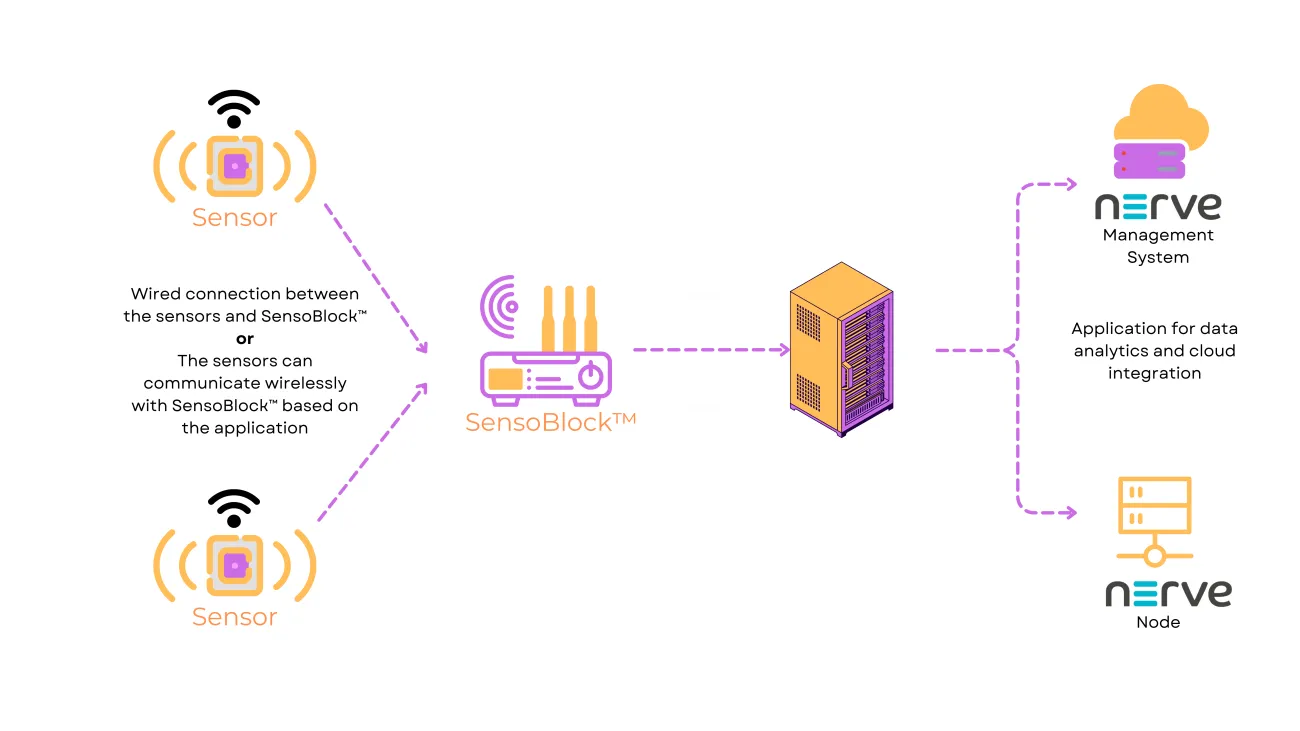
Alex Negoita-Tiu: SensoBlock acquires the high-resolution sensor data. It connects to an industrial PC (IPC) or server through a range of interfaces. Nerve runs on the IPC or serve and performs the filtering, feature extraction, and AI inference of the data at the edge. Then, Nerve forwards the reduced or enriched data to on-premises or cloud systems, where decisions based on this data are made. If changes are required at machine level, Nerve allows for updates, models, and new logic to be deployed securely.
This approach ensures low latency reactions directly at the machine, while still providing higher-level systems with the information they need. Even in isolated or unstable network environments, critical functionality remains fully operational.
What are the benefits for customers?
Alex Negoita-Tiu: The integrated solution of SensoBlock and Nerve provides engineering teams, OEMs, and operators with a unified IIoT architecture that supports long term maintainability. Customers can use deterministic, low latency processing at the asset/machine and generate high quality data through structured acquisition and preprocessing.
Miodrag Veselic: Both solutions offer CRA and NIS2 aligned secure lifecycle management and are capable of offline operation, which reduces dependency on cloud bandwidth and connectivity. In addition, they are modular solutions that allow scalable rollouts across machine fleets and facilities – meaning that they can grow with the business and use cases.
What are the challenges of retrofitting brownfield environments to make them ready for digital services?
Miodrag Veselic: Retrofitting is a challenge because you are working with legacy industrial assets that weren’t designed for data-driven business models and digital services that require connectivity, cloud integration, real-time data, and above all, high cybersecurity standards. Manufacturers often operate heterogeneous machine fleets comprising equipment from different vendors, generations, and security standards, making integration and interoperability a major hurdle. In addition, many existing systems rely on inflexible architectures and outdated software stacks that are difficult to adapt to modern digital environments.
As connectivity increases, it is more critical than ever to ensure cybersecurity, especially for legacy assets that were not designed to withstand today’s cyber threats. Companies also have to manage upgrades, maintenance, and secure software updates throughout often decades-long asset lifecycles while navigating growing regulatory requirements, for example through the Cyber Reliance Act (CRA) and NIS2 related obligations. At the same time, limited access to machine data can prevent organizations from leveraging analytics, predictive maintenance, and new digital services. Successfully addressing these challenges requires scalable, hardware-agnostic architectures that can securely connect existing assets, extend their operational lifetime, and unlock new value from long-running machine fleets.
Why are Nerve and SensoBlock a good combination to retrofit brownfield sites?
Alex Negoita-Tiu: SensoBlock generates high-quality sensor data and Nerve ensures that this data is processed, evaluated, and acted upon directly at the machine. SensoBlock’s non-intrusive design makes it suitable for retrofitting existing machinery without structural changes, an important advantage in brownfield environments. There is an optional battery operation for mobile or remote assets and during the development process, our engineers have ensured that the SensoBlock solution is compliant with the CRA and other European directives.
Miodrag Veselic: Nerve is cybersecurity certified and fulfills most requirements of CRA and NIS2. It is vendor-agnostic and allows for containerization and virtualization of applications, which is ideal when you are looking to security integrate legacy assets into a digital solution and connect them the to the Internet. Nerve also supports offline operation. Both SensoBlock and Nerve are modular and scalable and work together seamlessly – this is ideal for environments where existing machinery needs to be enhanced but the redesign of systems is either too costly or not possible.
Can you give some examples of digital services and IIoT use cases where Nerve and SensoBlock are a good fit?
Alex Negoita-Tiu: Yes, of course - the combination of SensoBlock and Nerve supports a wide range of applications across industries and is highly flexible and scalable from local machine diagnostics to distributed asset networks.
- Predictive maintenance: For rotating machinery, SensoBlock captures vibration and temperature data while Nerve identifies early signs of bearing wear, imbalance, misalignment, or overheating. Alerts can be generated locally, enabling rapid intervention.
- Rail infrastructure monitoring: Distributed sensor nodes collect displacement and vibration data from tracks or infrastructure components. Nerve preprocesses and correlates the data across locations, improving the reliability of inspections.
- Environmental and facility monitoring: Parameters such as humidity, air quality, or oxygen concentration are monitored in real time. Local edge dashboards and alarms support cleanrooms, warehouses, and data centers.
- Asset and people tracking: BLE/UWB based location tracking provides transparency in logistics hubs, hospitals, and industrial facilities, with Nerve processing signals and evaluating movement patterns.
- Remote agriculture: In areas with poor connectivity, SensoBlock captures GPS, motion, and temperature data from animals or equipment, while Nerve executes local logic to maintain operational continuity.
Thank you to Miodrag Veselic and Alex Negoita-Tiu for these insights – check out the links below for more information!
