Legacy industrial equipment was not designed for modern connectivity, cloud integration, or rising cybersecurity requirements, leaving many manufacturers stuck with multi-vendor hardware of varying ages and security levels, outdated software stacks, and limited access to machine data.
Regulations tighten, and digital service demands grow. Companies must adopt scalable architectures, secure update processes, and hardware‑agnostic strategies to safely extend the life of existing assets and unlock new value from long‑running machine fleets.
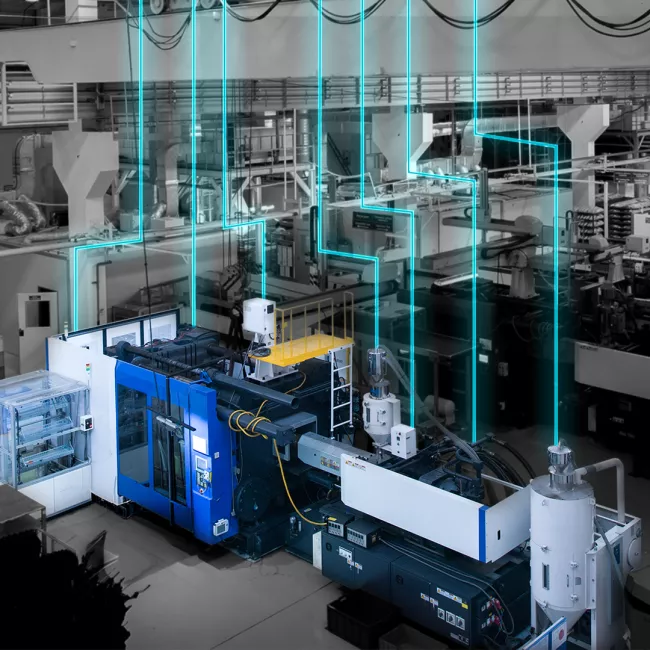
Digitalization of existing assets
is not a simple task
Digital services require machine connectivity on the shop floor and to the cloud. Machine data must be collected and processed in real time at the edge and/or transmitted to the cloud as needed. These requirements drive digital applications.
At the same time, cyberattacks on industrial companies increase. The Cyber Resilience Act (CRA) and NIS2 add further requirements. Robust cybersecurity and lifecycle support over 10–20 years are key requirements. They ensure future‑proof, secure digital applications.
They safeguard sensitive data
Hardware and scalability are key decision criteria
When it comes to new applications and functionalities, hardware and scalability are key decision criteria for OEMs. Hardware‑independent solutions enable companies to select the best fit for their machine. Software can be deployed and updated more easily. Centralized platform solutions make this more convenient.

Key challenges to modernized brownfield machines
Challenge 1: Integrating inflexible brownfield systems
Many machine builders and OEMs operate heterogeneous system landscapes that have evolved over many years and comprise a wide range of industrial PCs, Linux setups, and software versions. This leads to high service costs, susceptibility to errors, and prevents scaling. Older machines may have more capabilities than can be accessed with their existing control system, so they need to be connected securely within the system.
Challenge 2: Connecting legacy hardware from different providers
Within their brownfield and IT landscapes, companies may have a range of IPCs from different vendors installed on their machines. As computational requirements increase or in case of outdated or broken hardware, replacements would be required. This can involve a lot of time, effort, and cost, especially if hardware and software come as a package.
Challenge 3: Ensuring cybersecurity for products with digital components
Increasing cybersecurity requirements create compliance complexity for machine builders. Many brownfield architectures do not meet CRA and NIS2 requirements, such as update records, clear software versions, and secure remote access. In addition, some use cases may require special precautions for data transfer, and constant Internet access may not be desired or available.
Challenge 4: Handling upgrades and maintenance across the whole lifecycle
Long machine lifecycles of up to 20 years require consistent updates, maintainability, and remote support. At the same time, service in the field requires more effort when software versions are not clearly distinguished, or updates need to be distributed manually. For remote updates, a centralized management system and secure remote access to machines in the field with appropriate monitoring, logging, and access control are essential.
What is the solution?
A future‑proof solution combines hardware‑independent architectures, modern software stacks, robust cybersecurity, and structured lifecycle management to support new digital applications, regulatory requirements, and ongoing system growth. With the right foundation, legacy machines can be securely integrated, updated, and expanded without disrupting operations. Start with a free brownfield assessment to identify modernization potential, risks, and next steps for your machinery.
Our free assessment includes:
- High-level review of the existing industrial (brownfield) environment
- Identification of connectivity, integration, and data access challenges
- Initial assessment of legacy software and security constraints
- High-level recommendations for modernization and secure connectivity
- Definition of potential next steps tailored to your setup

Meet the expert
Miodrag Veselic
Miodrag Veselic is a seasoned professional in industrial automation, with deep expertise in safety systems, openSAFETY, and machine protection technologies. His work spans technical leadership, product innovation, and sales management roles at leading automation companies, including TTTECH Industrial and B&R Industrial Automation.
About us
TTTECH Industrial
TTTECH Industrial ist ein Unternehmensbereich der TTTECH Group, einer globalen Gruppe von High-Tech-Unternehmen mit Hauptsitz in Wien. TTTECH Industrial unterstützt Maschinenbauer und OEMs dabei, ihre Maschinen softwarefähig, vernetzbar und updatefähig zu machen. Dafür bietet TTTECH Industrial nicht nur die IIoT-Plattform Nerve, sondern auch Software- und Hardwareengineering, sowie Sicherheitstechnik für Industrieunternehmen.
